

Opaline Galore
April 13, 2022

Believe it or not, this small toothpick holder is from the late 1800s. Deep vertical grooves wrap the textured exterior. Although this small cruet is originally labeled as a toothpick holder, it can be used as an espresso cup or a shot glass.
Opaline glass dates back to the 16th century in Murano, Italy using calcination of bones. The technique continued to evolve in Germany and France through the year. In the 18th century, opaline glasses were produced in large quantities in France and was eventually adopted by American glass companies.
BRAND
A.J Beatty & Sons (1852 - 1892)
DIMENSIONS
D 2.25” / H 2”
MATERIAL
Glass
CARE
Clean with water and non-abrasive cloth. Light soap, as needed.
Dishwasher safe, top-rack only.
CONDITION
Excellent – Previously owned, like new

Depicting a right-footed boot with intricate lacing and bow details. There’s a hint of cranberry coloration in the ankle of the boot. Hobnail French (Opalescent) is a prized Fenton pattern, produced between 1939-1964. This pattern came in a variety of colors, including Blue, Cranberry, Vaseline and original (White).
Provenance is visible on the sole of the boot.
Opaline glass dates back to the 16th century in Murano, Italy using calcination of bones. The technique continued to evolve in Germany and France through the year. In the 18th century, opaline glasses were produced in large quantities in France and was eventually adopted by American glass companies.
BRAND
Fenton Art Glass Company (1905 - 2011)
DIMENSIONS
W 2.25” / L 4.25” / H 4.5”
MATERIAL
Glass
CARE
Clean with water and non-abrasive cloth. Light soap, as needed.
Dishwasher safe, top-rack only.
CONDITION
Excellent – Previously owned, like new

Top hat vase or pen holder.
Coinspot White is a rare Fenton pattern, produced between 1908-1912. While also available in Blue and Cranberry, Coinspot pattern far more difficult to find than its cousin, Coin Dot pattern which has inverted opalescent coloration.
Opaline glass dates back to the 16th century in Murano, Italy using calcination of bones. The technique continued to evolve in Germany and France through the year. In the 18th century, opaline glasses were produced in large quantities in France and was eventually adopted by American glass companies.
BRAND
Fenton Art Glass Company (1905 - 2011)
DIMENSIONS
W 5.25” / L 6“ / H 3.75”
MATERIAL
Glass
CARE
Clean with water and non-abrasive cloth. Light soap, as needed.
Dishwasher safe, top-rack only.
CONDITION
Excellent – Previously owned, like new
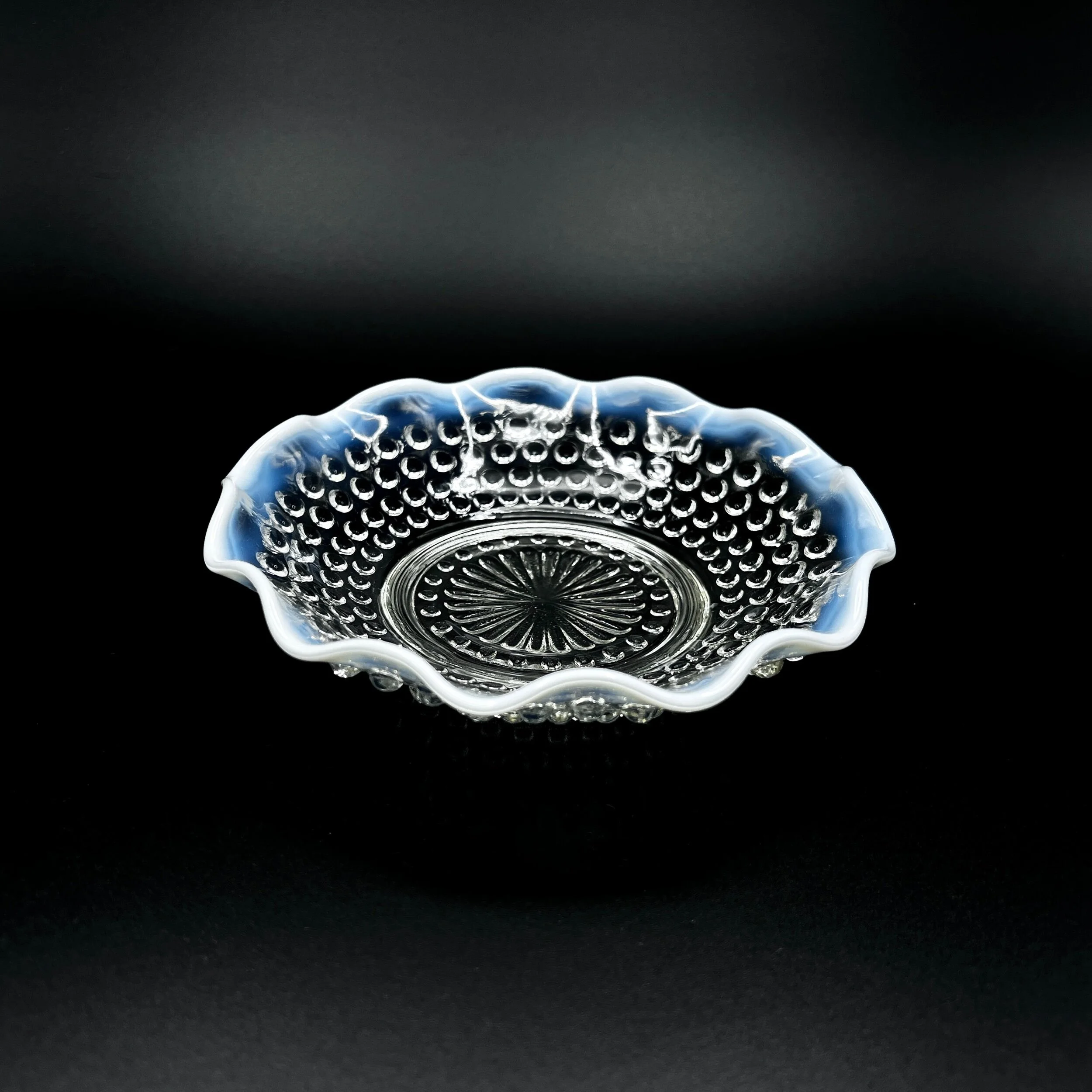
Small dish with crimped edge and hobnail textures on the underside. Moonstone is a discontinued Anchor Hocking pattern, produced between 1942-1946.
Opaline glass dates back to the 16th century in Murano, Italy using calcination of bones. The technique continued to evolve in Germany and France through the year. In the 18th century, opaline glasses were produced in large quantities in France and was eventually adopted by American glass companies.
BRAND
Anchor Hocking
DIMENSIONS
D 6” / H 1.25”
MATERIAL
Glass
CARE
Clean with water and non-abrasive cloth. Light soap, as needed.
Dishwasher safe, top-rack only.
CONDITION
Excellent – Previously owned, like new

Footed square bowl from the early 1900s, with delicate details that would match the then Art Nouveau home decor. Originally made as a fruit dessert bowl, this square beauty makes a great catchall dish.
Opaline glass dates back to the 16th century in Murano, Italy using calcination of bones. The technique continued to evolve in Germany and France through the year. In the 18th century, opaline glasses were produced in large quantities in France and was eventually adopted by American glass companies.
BRAND
Northwood Glass Company (1908 - 1925)
DIMENSIONS
W 3.75” / H 2”
MATERIAL
Glass
CARE
Clean with water and non-abrasive cloth. Light soap, as needed
CONDITION
Excellent – Previously owned, like new
Add

Candy jar with matching lid and handles decorated in beautiful hobnail texture with white accents. Moonstone is a discontinued Anchor Hocking pattern, produced between 1942-1946.
Opaline glass dates back to the 16th century in Murano, Italy using calcination of bones. The technique continued to evolve in Germany and France through the year. In the 18th century, opaline glasses were produced in large quantities in France and was eventually adopted by American glass companies.
BRAND
Anchor Hocking Glass Company
DIMENSIONS
L 7.5“ / H 4.5” / D 6“
MATERIAL
Glass
CARE
Clean with water and non-abrasive cloth. Light soap, as needed.
Dishwasher safe, top-rack only.
CONDITION
Excellent – Previously owned, like new

From a prolific collaboration in the 1940s between Wrisley of Chicago and Anchor Hocking Glass Company, The Moonstone Clear. Opalescent hobnail perfume bottle with corked stopper.
Moonstone is also a discontinued Anchor Hocking pattern, produced between 1942-1946.
Opaline glass dates back to the 16th century in Murano, Italy using calcination of bones. The technique continued to evolve in Germany and France through the year. In the 18th century, opaline glasses were produced in large quantities in France and was eventually adopted by American glass companies.
BRAND
Anchor Hocking Glass Company
DIMENSIONS
Bottle - D 4” / H 4.75”
Stopper - D 1.25” / H 2.5”
MATERIAL
Glass
CARE
Clean with water and non-abrasive cloth. Light soap, as needed.
Dishwasher safe, top-rack only.
CONDITION
Excellent – Previously owned, like new

Call it a maple leaf or marijuana leaf, the pinched shape is as unique as pressed glass go. The handle as well as the star shaped edges are dusted with white opalescent details.
Opaline glass dates back to the 16th century in Murano, Italy using calcination of bones. The technique continued to evolve in Germany and France through the year. In the 18th century, opaline glasses were produced in large quantities in France and was eventually adopted by American glass companies.
BRAND
Unidentified
DIMENSIONS
W 4.5” / L 6.25“ / H 2”
MATERIAL
Glass
CARE
Clean with water and non-abrasive cloth. Light soap, as needed.
Dishwasher safe, top-rack only.
CONDITION
Excellent – Previously owned, like new
Antique opaline glass fruit bowl dating back to the early 1900s. This three-part moulded glass has incredible details, most noticeably the ribbon-like opalescent edge.
Opaline glass dates back to the 16th century in Murano, Italy using calcination of bones. The technique continued to evolve in Germany and France through the year. In the 18th century, opaline glasses were produced in large quantities in France and was eventually adopted by American glass companies.
BRAND
Dugan Glass Company (1905 - 1913)
DIMENSIONS
D 9” / H 3.75”
MATERIAL
Glass
CARE
Clean with water and non-abrasive cloth. Light soap, as needed.
CONDITION
Excellent – Vintage wear consistent with age and use; one of the feet have a chip